

What you'll learn in this article
- What the SaaS-to-Service-as-Software narrative actually looks like when you read it through Google Ads search demand, not thought-leadership posts
- Why "saas trend" is down 71% year over year while "ai vs saas" is up 100%, and what that divergence is really measuring
- Why both terms sit at tiny absolute volume and why that changes how you're allowed to read the percentages
- The gap between a maturing category term cooling off and an emerging framing term warming up, and why they moved in opposite directions
- What I watch in the account when a topic is this early, this small, and this volatile
Most people read the shift from Software as a Service to Service as Software through essays and conference keynotes. I read it through the search bar, because search intent moves before the market narrative does and it's the earliest honest signal I get in an account. When I pull four years of demand for a pair of terms like "saas trend" and "ai vs saas" in the United States, the shape on the chart tells a cleaner story than any think-piece: one framing cooling as it matures, another warming as it becomes the question people actually type.
The framing itself isn't mine. It comes from a piece by Adarsh Singh Pawar, The Future of Software Isn't SaaS. It's Service as Software., which argues that AI is turning software from a tool you operate into a service that delivers the outcome directly. What follows is my attempt to test that argument against the demand data.
This is what the SaaS-to-Service-as-Software transition has looked like in the Keyword Planner data I work from, why one term is halving while the other doubles, and the handful of things I actually watch when a topic is this early and this small underneath the campaigns I'm running.
The numbers I see in the demand data
Pulled for the US over the July 2022 to June 2026 window, the two terms that frame this shift read like this:
| Keyword | Avg. monthly searches | 3-month change | YoY change | Competition | Top-of-page bid (low) | Top-of-page bid (high) |
|---|---|---|---|---|---|---|
| saas trend | 210 | -43% | -71% | Low | $5.29 | $20.25 |
| ai vs saas | 10 | -60% | +100% | Low | — | — |
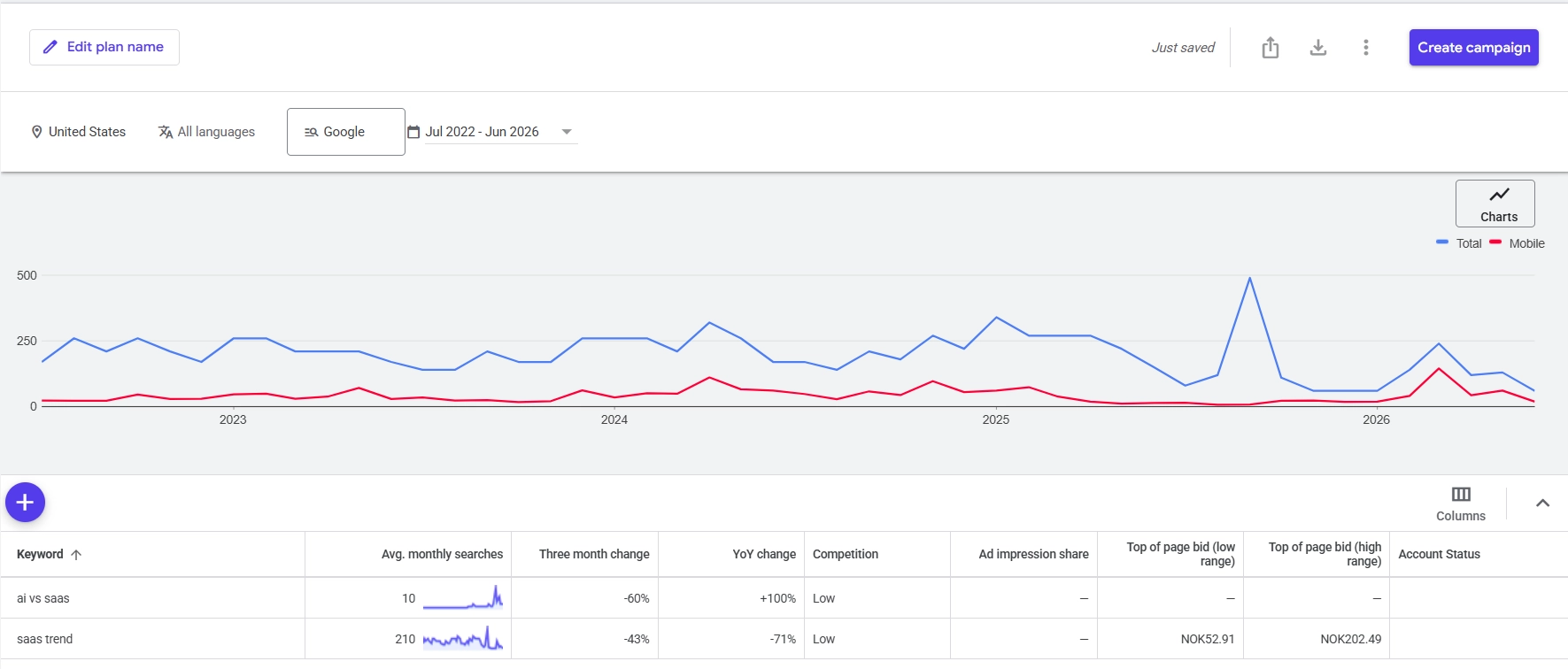
The first thing to say is that both numbers are small. 210 average monthly searches for "saas trend" and 10 for "ai vs saas" are not audiences you build a media plan around; they're signals you read. And at this scale, the percentages have to be handled with care a swing from 5 to 10 searches reads as "+100%" and means almost nothing on its own. So I treat these as directional evidence about where a conversation is heading, not as volume I can spend against today.
The shape of the divergence, not the snapshot
What's interesting isn't either number alone, it's that they point in opposite directions. "saas trend" carries a 71% year-over-year decline and a 43% drop in the most recent three months a term draining steadily. "ai vs saas" shows a 100% year-over-year rise sitting on top of a 60% three-month drop, which is exactly the jagged, unstable pattern you'd expect from a term that barely existed a year ago and is being searched in bursts rather than steadily. One curve is fading; the other is flickering into life.
Maturing term versus emerging term
The two keywords aren't the same question. "saas trend" is a maturing, generic category term the kind of phrase that peaks when a topic is novel and cools as it becomes assumed knowledge. "ai vs saas" is an emerging framing term, the shape a market takes when people stop asking "what's the trend in SaaS" and start asking "does AI replace the SaaS I already pay for". What matters is that they moved in opposite directions: the old framing fell 71% while the new framing doubled off a tiny base. That opposition is the clearest evidence I have that this is a narrative shifting rather than interest in the category disappearing.
Why this demand moved the way it did
A few forces have shaped this divergence, listed roughly by how much each one actually moved the number.
1. "Trend" terms decay as a topic matures
Generic "X trend" queries spike when a subject is new and people are orienting themselves, then fade as the subject becomes background knowledge. SaaS is no longer novel it's the default way software is sold so the exploratory "saas trend" query naturally drains. Much of that 71% is a topic growing up, not a topic dying.
2. The question is being reframed around AI
The interesting conversation moved from "how is SaaS evolving" to "does AI change the deal entirely" the Service-as-Software argument that writers like Adarsh Singh Pawar have been making all year: nobody actually wants software, they want the outcome on the other side of it. That reframing pulls curiosity out of the old generic term and into sharper comparison queries like "ai vs saas", which is why one drains while the other, however faintly, grows.
3. Comparison intent concentrates into sharper phrases
As a debate matures, broad exploratory searches give way to specific head-to-head phrasing. "ai vs saas" is that sharper phrasing arriving, and its volatility 100% up over the year but 60% down over the quarter is the signature of a term still finding its footing rather than a stable, established query.
4. Tiny-volume noise on top of everything
At 10 and 210 average searches, rounding and month-to-month randomness dominate the short-term movement. Google's own historical figures are rounded and modelled, so a large-looking percentage on a small base is often noise wearing the costume of a trend. This is the force I discount most deliberately, and the reason I never react to a single month here.
What I watch when a topic is this early and this small
Before drawing conclusions from either number, it's worth being precise about what Keyword Planner is giving you. Google's documentation on average monthly searches describes it as an average over the selected range, rounded and modelled and at this volume, that rounding is doing a lot of the work. The direction over the full window is the only part I actually trust here, never a single month.
Two consequences follow for terms this small. Low competition on both doesn't mean cheap, easy traffic it means there's barely a market to compete over yet, which is a different situation entirely. And a percentage swing on a base of 10 searches is not a demand signal you can bid against; it's a hint about where to point research, not budget.
Direction before magnitude
When volume is this low, the metric that matters isn't the number, it's the sign in front of it. A term consistently trending up over four years earns a watchlist slot even at 10 searches; a term halving year over year gets deprioritised regardless of its absolute size. I read the arrow, not the value.
Intent segmentation, not one bucket
A fading generic term and a rising comparison term are two different intents and shouldn't share a plan. If "saas trend" and "ai vs saas" ever grow into real volume, the buyers behind the comparison query are far closer to a decision than the ones behind the generic one. Keeping them separate now means the account is already structured correctly when volume arrives.
Watchlist, not spend
Terms at this scale belong on a monitoring list, not in an active campaign. I track them month over month for a sustained change in direction, and only move budget in once a rising term clears a volume floor that makes clicks actually purchasable.
Year-over-year framing, always
Because tiny-base noise is so strong here, every read I make is against the same month last year and across the multi-year curve. A month-on-month comparison on 10 searches will tell you a story the trend flatly contradicts.
What I infer from these numbers
This is a narrative shifting, not a category collapsing. "saas trend" draining while "ai vs saas" doubles reads as the conversation moving from a generic frame to an AI-centric one, not as interest in software leaving the building.
The old framing is cooling faster than the new one is heating. A 71% drop against a 100% rise off a tiny base means the decline is real and the emergence is still only a flicker don't overweight the doubling.
Low competition here isn't opportunity, it's earliness. Barely anyone is bidding because there's barely anything to bid on yet. That's a reason to watch, not a discount to exploit.
The trend line predicts better than the snapshot. If I had to bet on where this goes, it would be the direction of the multi-year curves not the average-searches figure sitting in either cell today.
The search data leads the commentary. The Service-as-Software argument is being written up now, in pieces like Adarsh Singh Pawar's essay, but the search behaviour that confirms it is only just starting to appear which is exactly why I read the demand curve as the leading indicator and the essays as the confirmation.
What I stopped doing
Reacting to percentages on tiny bases. A "+100%" on 10 searches is not a trend I can act on. At this volume, direction over years beats any single headline percentage.
Treating low competition as free opportunity. On terms this small, low competition means the market hasn't formed yet, not that I've found an underpriced one.
Running emerging and maturing terms in one bucket. A -71% term and a +100% term behaving in opposite directions is the whole point they belong on separate watchlists so one doesn't mask the other.
Confusing a trend query's decay with the category declining. "saas trend" fading is what a maturing topic does. Reading that as SaaS itself losing relevance gets the whole picture backwards.
The practical takeaway
Don't ask whether SaaS interest is falling the generic "saas trend" term is down 71% year over year, and that's real. Ask what kind of falling it is. Here it's a maturing topic's exploratory query cooling while the sharper, AI-centric framing "ai vs saas" flickers up 100% off a base so small the number can't yet carry weight on its own.
The SaaS-to-Service-as-Software shift, read through search, comes down to a trend term decaying as the topic matures, the conversation being reframed around AI, comparison intent concentrating into sharper phrases, and tiny-volume noise on top of all of it roughly in that order. Once you can name which of those is moving your number this quarter, the divergence stops reading as a paradox and starts reading as a narrative changing shape something you can watch deliberately and structure for before the volume ever arrives.
FAQ: SaaS and AI search demand on Google Ads
Is interest in SaaS actually declining?
Why is "ai vs saas" up 100% while "saas trend" is down?
Can I run campaigns on these keywords now?
The Service-as-Software framing in this article draws on Adarsh Singh Pawar, The Future of Software Isn't SaaS. It's Service as Software. (Randomly Systematic, July 2026). The demand-data reading is my own.